
One slice per number
1 is not larger than 20. There are no blank slices and no duplicate numbers in the default list.
The numbers 1 through 20 are already on the wheel. Spin to pick one. The number stays on the wheel, so the next spin can land on it again.
This is a random number wheel for a number from 1 to 20. Every number is already a slice. You do not set a minimum, a maximum, or a quantity first. Click the wheel and read the number on the winner card.
The same number can come up twice. That is the usual rule for a die, a spinner in a game, or a lesson where 7 is allowed to appear again. Nothing is removed after the spin.
Teachers use it for a problem number, a page, or a team size. Game nights use it when a board asks for a spin. A raffle that draws people, not numbers, belongs on the raffle page.
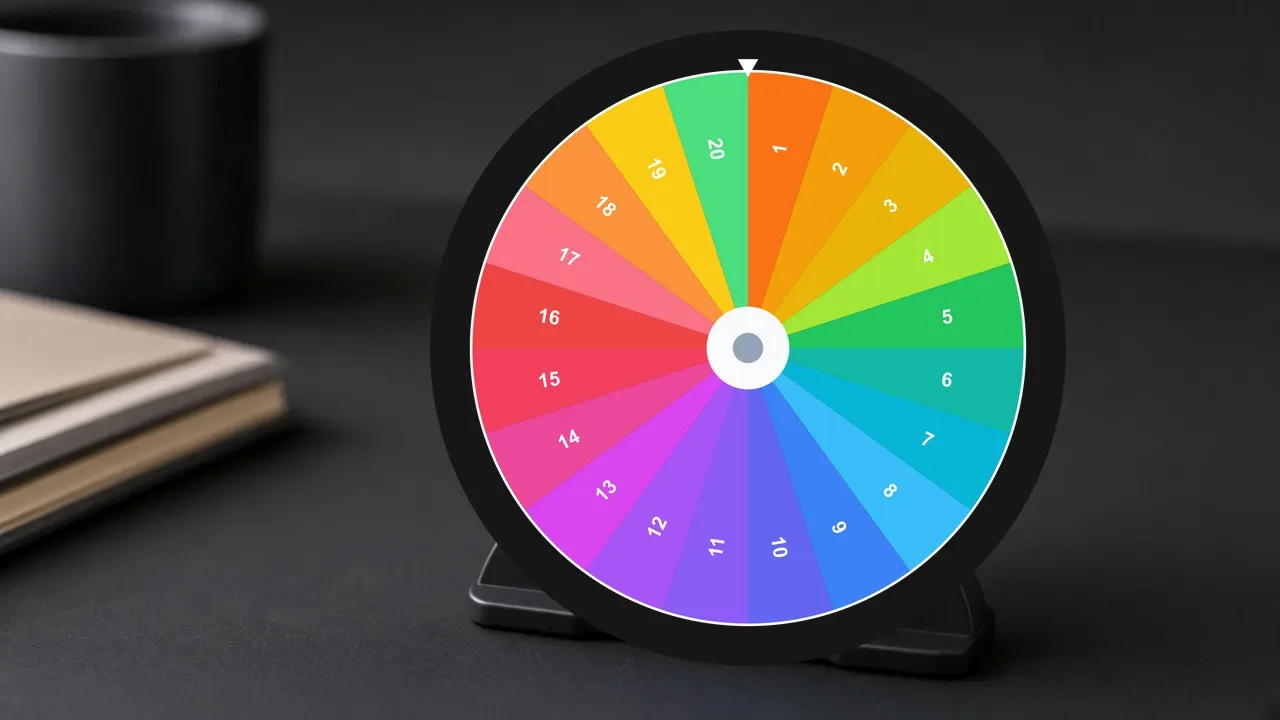

Leave the box as 1 through 20. Those twenty lines are the wheel.
Click the wheel and wait until it stops. The winner card shows the number.
Spin again for another number from the same range. History keeps the numbers you have already spun.
There are twenty lines, from 1 to 20, each with the same size slice. A spin is one of those twenty numbers, each with a 1 in 20 chance. You can use it immediately.
This list is saved separately from any names on the other pages. Changing a class roster does not change these numbers.
The wheel is only as fair as the lines in the box. Here those lines are 1 through 20, once each.
1 is not larger than 20. There are no blank slices and no duplicate numbers in the default list.
The number stays after it wins. If you need each number only once, open Customize and turn on "Remove the winner from the list automatically", or delete the line yourself after the spin.
A six-sided die is the lines 1 through 6. Delete 7 through 20 if that is the range you want. Do not leave the extra numbers in the box.
For 1 to 10, delete 11 through 20. For 1 to 6, keep the first six lines. For a bigger range, add the next numbers as new lines. Each line you leave in is one equal outcome.
Do not add 0 unless you want zero to be a result. Do not add the same number twice unless you want that number to be twice as likely.